


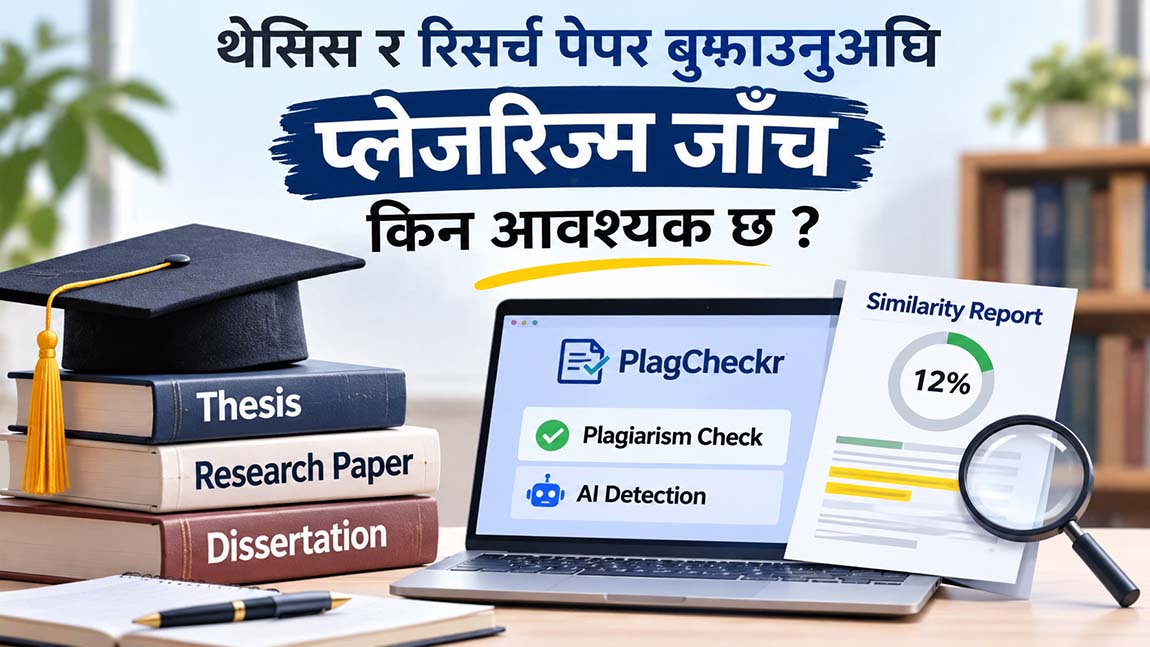
Kathmandu: Writing a thesis, dissertation, or research paper is one of the most important parts of a student's academic journey. From selecting a research topic and collecting data to analyzing findings and preparing the final document, the entire process can take months of dedicated effort.
However, even after completing the research, students may face an important challenge: ensuring that their work is original and properly referenced.
Unintentional plagiarism, missing citations, improperly paraphrased content, and similarities with previously published research can raise concerns during academic evaluation.
For students pursuing bachelor's, master's, MPhil, or PhD degrees in Nepal, checking a research paper for plagiarism before submission can be a valuable part of the final review process.
What Is Plagiarism in Academic Writing?
Plagiarism occurs when someone presents another person's words, ideas, research findings, or intellectual work as their own without proper acknowledgment.
In academic writing, plagiarism can occur in several ways, including:
Copying sentences or paragraphs without citing the original source.
Paraphrasing published research without appropriate references.
Using someone else's research findings or data without acknowledgment.
Reusing substantial portions of previously submitted work without proper disclosure.
Including quotations without the required citation or quotation formatting.
Not every instance of textual similarity constitutes plagiarism. Research papers often contain common terminology, technical descriptions, standard research methodologies, and properly cited quotations.
Therefore, a similarity percentage alone cannot determine whether a document contains plagiarism. The context and nature of the matching content must also be considered.
Why Should Students Check Their Thesis Before Submission?
Universities and academic institutions expect students to maintain academic integrity throughout their research.
A plagiarism check can help researchers identify potentially problematic sections before submitting their final documents.
For example, a student preparing a master's thesis may have referenced dozens of journal articles, books, and online publications. During the writing process, some citations may be overlooked, or certain sentences may unintentionally resemble existing publications.
Reviewing a similarity report can help identify these issues before the document reaches an academic supervisor or evaluation committee.
Such checks are particularly useful for students submitting dissertations, research proposals, journal manuscripts, and final-year research projects.
How to Check a Thesis or Research Paper for Plagiarism Online
Several online tools are available to help students and researchers review the originality of their academic documents.
One option is PlagCheckr, an online platform designed to analyze documents for plagiarism-related similarities and potential AI-generated content.
Students can upload supported academic documents, including research papers, assignments, and theses, for analysis.
Depending on the available report features, the results can help users review similarity percentages, highlighted passages, matching sources, and AI detection indicators.
These findings can help researchers identify sections that require additional citations, clearer attribution, or further review.
However, plagiarism-checking tools should be treated as academic review aids rather than final authorities on whether plagiarism has occurred.
Students should also review the university's submission guidelines and the privacy practices of any third-party service before uploading unpublished research.
What Is an Acceptable Plagiarism Percentage for a Thesis?
One of the most common questions students ask is: "How much plagiarism is allowed in a thesis?"
There is no single universally accepted percentage.
Different universities, faculties, journals, and academic departments may apply different similarity thresholds and assessment procedures.
Some institutions may establish numerical similarity limits, while others examine the nature of the matched content rather than relying exclusively on a percentage.
For example, a research paper may show textual similarity because of properly cited quotations, bibliography entries, standardized terminology, or commonly used methodological descriptions.
In contrast, a document with a relatively low similarity score may still contain plagiarism if important ideas or passages have been copied without attribution.
Students should therefore consult their supervisors or official university guidelines instead of assuming that a particular percentage guarantees acceptance.
Can AI-Generated Content Be Detected in Research Papers?
Artificial intelligence has become increasingly common in education and academic writing.
Students may use AI-powered tools to understand complex concepts, organize research materials, improve grammar, or develop initial outlines.
However, universities and academic publishers may have different rules regarding the permitted use and disclosure of AI assistance.
AI detection tools attempt to estimate whether a passage may have been generated by artificial intelligence by analyzing patterns within the text.
Unlike plagiarism detection, which focuses on similarities with existing sources, AI detection examines characteristics of the writing itself.
These systems are not completely reliable. Human-written content may sometimes be incorrectly identified as AI-generated, while AI-assisted text may not always be detected.
For this reason, AI detection results should not be considered conclusive evidence of academic misconduct.
Students should follow their institution's AI usage policy, disclose AI assistance where required, and maintain records of their research and writing process.
Important Things to Check Before Submitting a Research Paper
Before submitting a thesis, dissertation, or research paper, students should complete a final academic review.
Review citations and references: Ensure that all borrowed ideas, data, quotations, and research findings are correctly attributed. Follow the required citation style, such as APA, MLA, Chicago, or another format specified by the institution.
Check textual similarities: Review matching passages and determine whether they are properly cited, appropriately quoted, or need revision.
Verify research information: Recheck important facts, calculations, statistical results, and references to ensure accuracy.
Follow institutional guidelines: Confirm the required formatting, originality requirements, submission procedures, and policies concerning AI assistance.
Protect unpublished research: Before uploading a document to an online checking service, review its privacy policy, data-handling practices, and any confidentiality requirements imposed by the university.
Originality Matters More Than a Similarity Score
The purpose of academic research is not simply to produce a document with a low similarity percentage. It is to contribute meaningful knowledge through independent investigation, credible evidence, and critical analysis.
A high-quality thesis depends on its research methodology, reliability of findings, proper acknowledgment of sources, clarity of argument, and originality of interpretation.
Online plagiarism and AI detection tools can support this process by helping students review their documents before submission.
Ultimately, academic integrity remains the responsibility of the researcher.
For students preparing a final-year project, master's thesis, or doctoral dissertation, checking the document carefully, correcting citation issues, and following university guidelines can help make the submission process more reliable and academically responsible.