

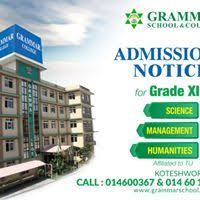
Grammar School & College
Education for a Brighter Life
0
Stories
0
Activities
0
Events
0
Photos
About Grammar School & College
About Grammar School & College
Education is more than the acquisition of knowledge or preparation for examinations. It is a process through which young people develop their abilities, discover their interests and learn to understand the world around them. A meaningful education should help students build a strong academic foundation while encouraging curiosity, creativity, confidence and responsible participation in society.
Grammar School & College, located at Setiopi Marga, Koteshwor, Kathmandu, is a private, English-medium, co-educational institution managed by Grammar Foundation Pvt. Ltd. Established in 1993, the institution has been working in the field of education for more than three decades. It offers school-level education, higher-secondary programmes and a bachelor's-level programme in business studies.
The institution uses the motto “Education for Bright Life”, reflecting its emphasis on education as a foundation for personal growth and future opportunities. Its stated educational approach focuses on academic development, practical learning, skills acquisition and the overall physical and mental growth of students.
The institution's educational philosophy recognises that students need opportunities to understand themselves, develop their abilities and engage meaningfully with the world. In addition to classroom instruction, its approach highlights activity-based and project-based learning, presentations, practical work and other educational activities.
For students and parents considering an educational institution, these elements are important because the quality of education depends not only on the prescribed curriculum but also on the learning environment, teaching practices, academic support and opportunities available to students.
Grammar School & College seeks to bring these dimensions together through its academic programmes, learning resources, extracurricular activities and emphasis on continuous educational development.
Academic Programmes
School-Level Education: Building a Strong Foundation
The school years provide the foundation for a student's academic journey. During this period, students develop essential literacy, numeracy, communication and problem-solving skills while gradually discovering their interests and abilities.
Grammar School & College provides school-level education from the early years through secondary education. Its educational approach emphasises English-medium instruction, academic development and opportunities for students to acquire knowledge and practical skills.
At the school level, effective learning involves more than memorising information. Students need opportunities to ask questions, participate in classroom activities, work collaboratively and connect their lessons with everyday experiences.
Activity-based and project-based approaches can help students develop these abilities. Classroom discussions encourage participation, while projects allow learners to investigate topics, organise information and present their findings.
A supportive school environment can also help students develop discipline, confidence, responsibility and respect for others. These qualities provide a foundation for the transition to higher-secondary education and further academic pursuits.
+2 Science: Exploring the Natural and Scientific World
Science education helps students understand the natural world through observation, experimentation, evidence and logical reasoning. It is particularly relevant to students interested in medicine, engineering, information technology and other scientific and technological disciplines.
Grammar School & College offers a +2 Science programme under the National Examination Board (NEB) framework, according to available institutional information.
The programme provides students with a foundation in scientific subjects while preparing them for further academic study. Science education requires learners to understand concepts, apply mathematical reasoning, examine evidence and develop systematic approaches to problem-solving.
Practical work is an important part of this process. Laboratory activities can help students connect theoretical knowledge with observation and experimentation, while assignments and problem-solving exercises encourage them to apply what they have learned.
After completing Grade 12, students may explore further studies in fields such as medicine, engineering, computer science, agriculture and other scientific disciplines, depending on their subject combinations and the admission requirements of the institutions they choose.
For students considering the Science stream, it is important to review the current subject combinations and ensure that they align with their interests and intended university programmes.
+2 Management: Understanding Business and Economic Activity
Management education introduces students to the principles that influence businesses, organisations, markets and financial decisions. It can provide a useful foundation for students interested in accounting, finance, economics, entrepreneurship and business administration.
Grammar School & College offers a +2 Management programme under the NEB framework. The programme is intended to provide students with a foundation for further study in business and management-related disciplines.
Management education helps students understand how organisations function, how resources are managed and how decisions influence outcomes. Accounting develops an understanding of financial records and reporting, while economics examines markets, resource allocation and economic behaviour. Business-related subjects introduce students to organisational practices and commercial activities.
The programme can also help students develop numerical reasoning, communication, analytical thinking and decision-making skills. Presentations, group assignments and project work provide opportunities to organise information, explain ideas and collaborate with others.
Following Grade 12, students may consider further education in business administration, business studies, finance, accounting, economics and related fields, subject to the admission criteria of the respective institutions.
For students interested in business and entrepreneurship, Management can offer an academic foundation for understanding both the practical and analytical dimensions of organisational life.
Bachelor's Degree in Business Studies
Grammar College also offers the Bachelor of Business Studies (BBS) programme affiliated with Tribhuvan University (TU). The programme extends the institution's academic provision into undergraduate education and provides students with an opportunity to continue studying business and management after higher-secondary education.
BBS is a four-year undergraduate programme that covers key areas of business studies, including accounting, economics, finance, marketing, management and business law.
The programme is designed to develop an understanding of business operations and organisational decision-making. Students study the principles underlying commercial activity while developing analytical, communication and problem-solving skills relevant to professional and entrepreneurial settings.
Business education at the bachelor's level requires students to move beyond introductory concepts and examine how different aspects of an organisation interact. Financial planning, marketing decisions, human resource management and business strategy are connected areas that influence organisational performance.
The programme can provide a foundation for students considering careers in business, banking, accounting, management and entrepreneurship, as well as further academic or professional qualifications.
Prospective students should confirm the current admission requirements, course structure and examination arrangements with Grammar College and Tribhuvan University before applying.
Activity-Based and Project-Based Learning
Learning becomes more meaningful when students have opportunities to apply knowledge rather than simply memorise information.
Grammar School & College highlights activity-based and project-based teaching and learning as part of its educational approach. Its institutional descriptions also refer to presentations, experiments, practical work, project assignments, term papers, workshops, seminars and guest lectures.
These activities can support different dimensions of student learning. Experiments allow students to examine scientific principles in practice. Presentations help learners organise ideas and communicate them effectively. Project work encourages research, planning and the application of knowledge to a particular question or task.
Workshops and seminars can provide opportunities for discussion and exposure to ideas beyond regular classroom lessons. Guest lectures may also help students understand how academic knowledge connects with professional experience.
Such activities are valuable when they are integrated into the curriculum and supported by constructive feedback. Students benefit when they have opportunities to ask questions, evaluate their work and improve their understanding over time.
Project-based learning can also encourage cooperation and responsibility. Students working together must communicate, divide tasks, manage time and contribute towards a shared outcome.
These skills can remain useful throughout further education and professional life.
Teaching, Academic Development and Institutional Management
The quality of education depends on the relationship between the curriculum, teachers, students and the wider institutional environment.
Grammar School & College describes its foundation as a team of experienced, professional and dedicated teachers. Its institutional profile emphasises academic quality, creative learning environments and professional leadership.
The institution also refers to the use of digital, activity-based and project-based teaching approaches. Digital resources can help teachers present information in different formats, while practical activities encourage students to participate more actively in learning.
A well-organised educational environment also requires effective communication, appropriate academic planning and cooperation among teachers, students, parents and the administration.
For students, these elements can influence their ability to understand lessons, seek guidance and develop consistent study habits. For parents, communication with the institution can provide a clearer understanding of academic expectations and student progress.
The effectiveness of any educational approach ultimately depends on how consistently it is implemented and how well it responds to students' learning needs.
Library, Laboratories and Learning Resources
Educational facilities support the process of learning by providing students with access to information, practical experiences and spaces for independent study.
Grammar School & College is listed among institutions providing a library, science laboratories, computer facilities, internet access and multimedia-supported classrooms. Available institutional directories also identify an e-library, conference facilities and other academic resources.
A library plays an important role in developing reading habits and supporting independent study. Access to books, reference materials and other learning resources can help students deepen their understanding of prescribed subjects and explore topics beyond the classroom.
Science laboratories allow students to connect theoretical knowledge with practical investigation. Laboratory work can help learners develop observation skills, follow procedures and interpret results.
Computer facilities and digital resources are increasingly relevant across academic disciplines. Students use technology to research topics, prepare assignments, organise information and develop digital literacy.
Classrooms equipped with multimedia resources can provide additional ways of presenting information and supporting discussion. Conference and seminar spaces can accommodate presentations, workshops and academic gatherings.
Prospective students and parents should confirm the current availability, equipment and arrangements for individual facilities directly with the institution.
Student Activities and Extracurricular Development
Education extends beyond scheduled classes and examinations. Extracurricular activities can help students explore interests, develop confidence and learn how to work with others.
Grammar School & College's available institutional listings identify sports, music, dance, educational tours, clubs and other extracurricular activities among its student development opportunities.
Sports can encourage physical fitness, discipline, teamwork and respect for shared rules. Music and dance provide opportunities for artistic expression and creative participation. Educational tours can expose students to places, people and experiences beyond their usual learning environment.
Clubs and group activities can also help students develop organisational and communication skills. When students participate in planning events, coordinating responsibilities and working with peers, they gain opportunities to practise leadership and cooperation.
Such activities can contribute to a balanced educational experience by providing opportunities to develop abilities that may not be fully expressed through academic subjects alone.
The value of extracurricular participation depends on the quality of the activities, the opportunities available to students and the extent to which they are encouraged to participate meaningfully.
Sports, Well-being and Personal Development
Physical and mental development are important parts of a student's educational experience. A supportive institution should encourage students to maintain healthy habits, participate in physical activities and develop positive relationships with others.
Grammar School & College is listed as providing sports facilities and extracurricular opportunities intended to support student participation beyond the classroom.
Sports can help students learn perseverance, cooperation and self-discipline. Team activities encourage participants to work towards shared goals, while individual activities can help develop concentration and personal responsibility.
A balanced educational experience also requires students to manage their time effectively. Academic study, recreation, physical activity and rest all contribute to a student's ability to maintain consistent learning habits.
The institution's stated emphasis on students' overall physical and mental growth reflects the importance of viewing education as a broader developmental process rather than solely as examination preparation.
Research, Academic Publishing and Indigenous Knowledge
One distinctive aspect of Grammar College's wider academic activity is its association with the Journal of Indigenous Knowledge and Practice (JIKaP).
The journal's first volume, published in 2025, describes it as a peer-reviewed, multidisciplinary academic publication focused on indigenous knowledge and practice. Grammar College is identified as its publisher.
The journal provides a platform for scholars, educators, researchers and professionals to publish work relating to indigenous knowledge, cultural practices and other academic subjects. Its stated purpose includes promoting evidence-based research and connecting knowledge with practical and social contexts.
Academic publishing can contribute to an institution's intellectual environment by encouraging research, discussion and the exchange of ideas. It also provides a way to document knowledge and make research available to wider audiences.
The journal's focus on indigenous knowledge is particularly relevant in a country such as Nepal, where communities maintain diverse linguistic, cultural and practical traditions. Research in this area can contribute to understanding local knowledge systems and examining their relevance to contemporary social and environmental questions.
The publication is an academic activity associated with Grammar College and should be distinguished from the school's regular school-level and higher-secondary programmes.
Preparing Students for Further Education and Professional Life
The purpose of education is not limited to completing a prescribed curriculum. It also involves helping students develop the knowledge, habits and skills needed to make informed decisions about their futures.
Grammar School & College offers academic pathways from school-level education through +2 Science and Management to undergraduate business studies. This range of provision allows students to explore different stages of education within the institution.
Students completing Science may consider further studies in scientific and technological fields, while Management students may pursue business, accounting, finance and related disciplines. Those completing BBS can explore employment and further study opportunities connected with business and management.
These pathways depend on individual academic performance, subject choices, admission criteria and future qualifications. Students should therefore seek accurate information before deciding which programme best suits their interests.
The institution's emphasis on practical and project-based learning also highlights the importance of transferable skills. Communication, collaboration, research, problem-solving and responsible conduct can support students across a wide range of academic and professional environments.
For young people, the years spent at school and college can be an opportunity to discover their strengths, develop new interests and prepare for the responsibilities of adult life.
More Than Academic Qualifications
A meaningful education should help students become capable learners and responsible members of society. Academic knowledge provides an essential foundation, but its value increases when students can apply it thoughtfully and communicate it effectively.
Grammar School & College's stated approach brings together formal academic programmes, practical learning, digital teaching methods, extracurricular activities and wider academic engagement. Its motto, “Education for Bright Life”, expresses the idea that education should contribute to students' future opportunities and personal development.
For students and parents considering the institution, it is useful to examine the quality of teaching, programme structure, available resources, student support and opportunities for participation. Current admission requirements, fees, scholarships and programme details should also be verified directly with the institution.
The most suitable educational environment is one that matches a student's interests, abilities and aspirations while providing the guidance needed to progress academically.
Ultimately, education is not simply a qualification obtained at the end of a course. It is a process through which students develop the ability to learn, question, create and contribute. These abilities can help shape their choices long after they leave the classroom.
Grammar School & College's educational philosophy, as expressed in its institutional descriptions, places this wider purpose alongside academic learning.
Grammar School & College at a Glance
Institution: Grammar School & College
Management: Grammar Foundation Pvt. Ltd.
Established: 1993
Location: Setiopi Marga, Koteshwor, Kathmandu-32, Nepal
Institutional Type: Private, English-medium, co-educational institution
School-Level Education: Early years through secondary level
Higher-secondary Programmes: +2 Science and Management
Bachelor's Programme: Bachelor of Business Studies (BBS)
Affiliation: National Examination Board (NEB) for higher-secondary programmes; Tribhuvan University (TU) for BBS
Academic Facilities: Library, science laboratories, computer facilities, internet access, multimedia classrooms and seminar/conference facilities
Student Development: Sports, music, dance, educational tours, clubs and extracurricular activities
Teaching Approach: Activity-based learning, project-based learning, presentations, experiments, practical work, workshops and seminars
Academic Publication: Journal of Indigenous Knowledge and Practice (JIKaP), first volume published in 2025
Contact & Leadership
Latest from Grammar School & College
Nothing published for this institution yet.