

Lincoln School Nepal
A School for Skillful Knowledge and Academic Excellence
0
Stories
0
Activities
0
Events
0
Photos
About Lincoln School Nepal
About Lincoln School Nepal
Established in 1954, Lincoln School Nepal is an independent, co-educational day school located in Rabi Bhawan, Kathmandu. It provides an enriched North American college-preparatory education to students from Preschool and Pre-Kindergarten through Grade 12.
Lincoln School serves a multicultural community in the Kathmandu Valley, bringing together students and educators from different national and cultural backgrounds. Its educational philosophy centres on developing a passion for learning, the confidence and competence to pursue individual aspirations, and a commitment to serving as compassionate global citizens and responsible leaders.
The school offers an American curriculum with an international perspective, leading to an American high school diploma. Its programme combines academic study, elective courses, extracurricular activities and opportunities for personal development.
Lincoln's mission also emphasises environmental responsibility. Students are encouraged to understand their role in the wider world and become thoughtful stewards of the environment.
The school's core values are Learning, Compassion, Respect, Integrity, Collaboration and Responsibility. These values inform its academic culture, relationships and wider school community.
Grade 12.+1
Academic Programs
Lincoln School organises its academic programme into three divisions: Elementary School, Middle School and High School. The programme extends from early childhood education to Grade 12, with learning experiences adapted to students' developmental stages.
Elementary School
The Elementary School division provides the foundation for students' academic, social and personal development. Its approach encourages curiosity, active participation and the development of essential skills.
Students build foundational knowledge through classroom learning and a range of experiences that support literacy, communication, creativity and independent thinking. Activities such as reading programmes, collaborative projects and creative classroom work contribute to the development of a positive learning environment.
The school's emphasis on student well-being and individual growth is reflected in its commitment to a supportive, community-oriented learning experience.
Middle School
The Middle School division focuses on inquiry, experimentation and discovery. Its curriculum encourages students to investigate ideas, ask questions, explore different subject areas and develop a deeper understanding of the world around them.
Interactive and project-oriented classroom environments provide opportunities for creativity, problem-solving and academic development. The school follows a standards-based assessment model to support students in building knowledge and skills.
Middle School also recognises the physical, emotional and social changes associated with adolescence. Learning support, academic enrichment, social interaction, artistic expression, service learning and athletics are incorporated into the student experience.
Student leadership is encouraged through an active Middle School Student Council, which provides a platform for students to express their views, participate in school activities and develop organisational and collaborative abilities.
Middle School
High School
The High School division offers a college-preparatory programme designed to develop academic knowledge, intellectual independence and essential life skills.
Students study a combination of core subjects and elective courses, allowing them to explore academic interests and areas of personal strength. The curriculum places particular emphasis on critical thinking, inquiry, collaboration and independent research.
A distinctive feature of the programme is its three-semester Theory of Knowledge course, which encourages students to examine how knowledge is developed, interpreted and applied.
High School students also complete a Senior Project, a core graduation requirement that combines original research, an extended essay and a performance or presentation in a creative or academic field selected by the student.
The school offers a broad selection of Advanced Placement (AP) courses for interested and motivated students. This allows students to pursue more advanced academic study and work towards an AP International Diploma where they meet the relevant requirements.
Academic and learning support programmes, including English for Speakers of Other Languages (ESOL), help address the needs of a diverse student population.
High School
Learning Beyond the Classroom
Lincoln School places considerable emphasis on inquiry, project-based learning and experiences that connect academic knowledge with the wider world.
In the Elementary School, learning includes planned play, teacher-guided activities and child-initiated exploration. Students investigate questions, develop ideas and participate in activities that nurture creativity, critical thinking and problem-solving.
The school also integrates service learning into its academic programme. Students investigate community needs, reflect on possible solutions and take action through projects connected to four areas: animals, the environment, people and education.
At the secondary level, cross-disciplinary learning and student choice are important features. Students have opportunities to engage in research, creative projects, collaborative investigations and community-based activities. The Innovation Lab is another example of the school's inquiry-driven approach, providing opportunities for students to explore ideas and develop projects connected to their interests.
Program Overview+2
Facilities & Student Life
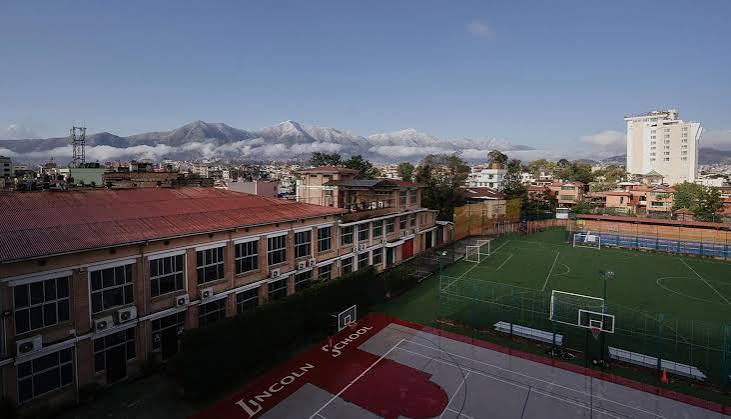
Lincoln School has a purpose-built campus in Rabi Bhawan, Kathmandu, designed to support academic learning, physical education, creative expression and community activities.
The school reports having 35 classrooms across three buildings, alongside specialised facilities for learning and student life.
Its major facilities include:
Classrooms: Dedicated learning spaces across the Elementary, Middle and High School divisions.
Library and Media Centre: A three-storey library and media facility supporting reading, research and digital learning. The High School library provides access to more than 14,000 print and digital resources.
Theatre: A dedicated space for performances, productions and school events.
Gymnasium: An indoor facility supporting physical education and athletic activities.
Swimming Pool: A heated 25-metre swimming pool supporting swimming instruction and competitive development.
Outdoor Sports Areas: Outdoor fields, courts and rooftop athletic and play areas.
Technology Resources: Wireless campus-wide internet, portable Mac and iPad devices, and a bring-your-own-device programme in secondary school.
Food Services: Freshly prepared vegetarian and non-vegetarian meals, snacks and a range of international food options.
Transportation: Air-conditioned buses and vans serving different areas of Kathmandu and Lalitpur.
Health Office: A school nurse provides first aid, emergency care, health education and support for students with individual health needs.
The campus infrastructure is intended to provide students with opportunities to learn, participate and develop interests beyond conventional classroom instruction.
Facilities+4
Student Activities
Arts, athletics and extracurricular activities are considered an important part of the educational experience at Lincoln School. Students are encouraged to explore interests, develop talents, build relationships and participate in activities that complement their academic programmes.
The school is a member of the South Asia Inter-School Association (SAISA), a regional network of international schools that organises athletic, artistic, cultural and academic events.
Sports and Athletics
Students have opportunities to participate in a variety of sports, including:
Basketball
Football
Volleyball
Swimming
Track and field
Badminton
Tennis
The school also offers development programmes for students who wish to improve their sporting skills before participating in competitive teams. Swimming instruction and development programmes are available for different age groups.
SAISA+1
Arts and Creative Activities
The school's arts programme includes visual and performing arts. Students can participate in music, theatre, visual arts and creative projects.
Activities include choir, instrumental music, band performances, drama productions, photography, ceramics, sculpture, painting and printmaking. Students also have opportunities to exhibit their artwork and participate in regional arts and music events.
After-School Activities
Lincoln's after-school programme is organised around nine strands of lifelong learning:
Creativity, Strategy and Innovation
Imagination and Performance
Shaping World Leaders
Movement
Team Sports
Music
21st Century Media
Brain
Service
The programme offers more than 90 activity options across its sessions, allowing students to explore interests ranging from sports and music to creative writing, leadership and service.
Arts+1
Leadership and Academic Activities
Student leadership is encouraged through organisations such as the Student Council and National Honor Society. Students also participate in Model United Nations, service initiatives, academic activities and regional events.
These experiences help learners develop confidence, communication, collaboration, responsibility and organisational skills.
Educational Approach
Lincoln School follows a student-centred educational philosophy that combines academic challenge with personal development, inquiry and community engagement.
Its approach is guided by the belief that education should help students become independent thinkers who can pursue their interests, work collaboratively and contribute positively to society.
Several principles shape its educational environment:
Inquiry and Critical Thinking: Students are encouraged to ask questions, investigate ideas, evaluate information and develop independent perspectives.
Personalised Learning: Small class sizes and learning support programmes help teachers respond to students' individual needs and learning development.
Cross-Disciplinary Learning: Academic subjects are enriched through connections with technology, theatre, music, fine arts, service learning and physical education.
Collaboration: Students develop the ability to work with others through classroom projects, student organisations, extracurricular activities and community initiatives.
Global Citizenship: The school encourages cultural understanding, compassion, environmental responsibility and active participation in society.
Lincoln School is accredited by the Middle States Association of Colleges and Schools – Commissions on Elementary and Secondary Schools (MSA-CESS) in the United States. The accreditation supports the school's commitment to educational quality, student achievement and professional learning.
Accreditation+2
Admission Policy & Student Support
Lincoln School welcomes applications from families interested in its international, college-preparatory educational programme. The school provides separate registration-of-interest and admission application processes through its Admissions Office.
Prospective families can contact the admissions team to obtain information about available places, application requirements, academic placement and the admission process. The school does not publish a complete set of current admission criteria, age requirements or application deadlines on the general information pages reviewed for this profile. Families should therefore confirm these details directly with the Admissions Office.
Student support is an important part of the school's educational provision. Its Student Services Programme offers integrated assistance in the following areas:
Elementary and secondary learning support
English language development through ESOL
School counselling
College counselling
Occupational therapy
Speech and language support
Mental health and social-emotional support
Health services
The Student Services team includes specialist teachers, counsellors, a health specialist, an occupational therapist, a speech and language specialist and a mental health social worker. The school describes this as a collaborative approach to supporting students' academic, social, emotional and language development.
The school also maintains child protection and safeguarding guidelines designed to protect students' rights, dignity and safety.
Student Services+2
Community Engagement & Global Outlook
Lincoln School's multicultural character is central to its identity. Students and faculty come from different countries and cultural backgrounds, creating an international learning environment in which cross-cultural understanding and collaboration are part of everyday school life.
Community engagement is reflected in the school's service-learning programme and its wider partnerships in Nepal. Through Service Nepal, students participate in community-based learning experiences that combine teamwork, cultural understanding, individual challenges and meaningful service.
Elementary students undertake classroom investigations related to animals, the environment, people and education. These activities encourage learners to understand local issues, consider possible responses and contribute to their communities.
The school's participation in SAISA provides further opportunities for international engagement. Students interact with peers from other countries through sporting competitions, arts festivals, music programmes, leadership activities and Model United Nations events.
Community events such as International Day, the Welcome Back Picnic and other school-wide activities also bring together students, parents, alumni, teachers and staff.
Through these initiatives, Lincoln seeks to develop students who are internationally aware, socially responsible and committed to making positive contributions to the communities in which they live.
Service Learning+2
Lincoln School Nepal at a Glance
Particulars | Details |
|---|---|
Institution Name | Lincoln School Nepal |
Established | 1954 |
Location | Rabi Bhawan, Kathmandu, Nepal |
Institution Type | Independent, non-profit, co-educational day school |
Academic Levels | Preschool, Elementary, Middle and High School |
Grade Range | Preschool and Pre-Kindergarten to Grade 12 |
Curriculum | American curriculum with an international perspective |
Qualification | American High School Diploma |
Advanced Courses | Advanced Placement (AP) courses |
Accreditation | Middle States Association of Colleges and Schools – Commissions on Elementary and Secondary Schools (MSA-CESS) |
Educational Approach | Student-centred, inquiry-based and college-preparatory learning |
Core Values | Learning, Compassion, Respect, Integrity, Collaboration and Responsibility |
Key Learning Areas | English, Social Studies, Science, Mathematics, Technology, Fine Arts and World Languages |
Learning Facilities | Classrooms, library/media centre, theatre, gymnasium, swimming pool and outdoor sports areas |
Technology | Campus-wide wireless internet, Mac and iPad resources |
Sports | Basketball, football, volleyball, swimming, track and field, badminton and tennis |
Arts & Activities | Music, choir, theatre, visual arts, Model United Nations and after-school programmes |
Student Support | ESOL, learning support, counselling, college guidance and specialist services |
Community Programmes | Service learning, Service Nepal and community events |
International Participation | South Asia Inter-School Association (SAISA) |
Transportation | Air-conditioned buses and vans serving Kathmandu and Lalitpur |
General Contact | +977 1-5371436 |
Additional Telephone | +977 1-5370482 |
Admissions Email | |
Postal Address | P.O. Box 2673, Rabi Bhawan, Kathmandu, Nepal |
Contact & Leadership
Latest from Lincoln School Nepal
Nothing published for this institution yet.