Mid Valley SS/College
Where Learning Looks Beyond the Classroom
0
Stories
0
Activities
0
Events
0
Photos
About Mid Valley SS/College
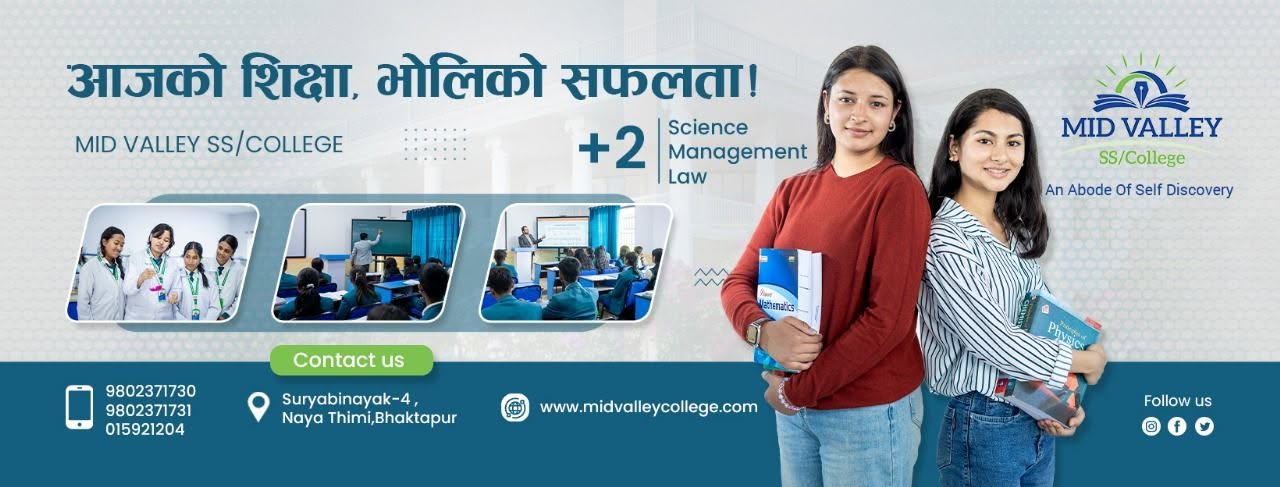
With programmes in Science, Management and Law, Mid Valley SS/College seeks to combine academic knowledge with practical learning, critical thinking, creativity and the broader development of students.
Choosing a college after SEE is rarely just about choosing a subject. It is also about choosing a learning environment in which a young person's interests, abilities and ambitions begin to take shape.
For students entering Grade 11, the two years ahead are more than a preparation for another examination. They are a transition from general education towards a more defined academic direction. The quality of teaching, learning environment, practical exposure, access to resources, extracurricular opportunities and the relationship between teachers and students can all influence that experience.
Located at Naya Thimi, Suryabinayak-4, Bhaktapur, Mid Valley SS/College is a higher-secondary institution offering three academic programmes under the National Examination Board: Science, Management and Law. Alongside the prescribed curriculum, the college places emphasis on practical learning, project work, presentations, innovation, critical thinking, leadership and extracurricular engagement.
Its educational philosophy rests on an idea that is increasingly relevant to contemporary education: learning should not end with remembering information. Students should also be encouraged to understand, question, apply and create.
Academic Programmes
Science: Learning Through Inquiry and Practice
For students drawn towards mathematics, scientific investigation and the natural sciences, the Science programme provides a foundation for further study in a wide range of fields.
The curriculum includes compulsory Nepali and English, Mathematics, Physics and Chemistry, with students having options including Biology and Computer Science. The programme combines classroom instruction with practical activities designed to help students understand scientific concepts through observation and experimentation.
Science education, after all, is not simply about memorising formulas or definitions. It is about learning to observe carefully, ask questions, examine evidence and arrive at reasoned conclusions. Practical laboratory work can therefore become an important bridge between what students read in textbooks and what they encounter in the physical world.
The programme prepares students for a variety of higher-education pathways, including medicine, engineering, information technology, pharmacy, agriculture and the pure sciences. (midvalleycollege.edu.np)
Management: Connecting Knowledge with the Real World
The Management programme is designed for students interested in business, economics, accounting, entrepreneurship and organisational studies.
Students study compulsory Nepali and English alongside subjects such as Accounting, Economics and Business Studies, with options including Mathematics, Computer Science, Hotel Management, Social Studies and Travel and Mountain Studies, depending on the available combination.
The programme seeks to develop more than familiarity with business terminology. Analysis, communication, numerical reasoning, decision-making and an understanding of how organisations and markets operate are increasingly important skills in contemporary professional life.
For students planning to continue into areas such as BBA, BBS, BIM, BIT, BCA and related fields, the +2 Management programme can provide an academic foundation while also introducing them to the practical language of business and enterprise.
Law: Understanding Society Through the Lens of Law
The Law programme offers students an opportunity to begin studying legal concepts at the higher-secondary level.
The curriculum includes subjects such as Jurisprudence and Legal Theories, Procedural Law and Constitutional Law. At the Grade 12 level, students encounter areas including the Nepalese Legal System, Legal Drafting, Civil and Criminal Law and Justice.
The significance of studying law at this stage extends beyond preparation for a future legal career. Law is closely connected with citizenship, rights, responsibilities, institutions and social relationships. Understanding how legal systems work can therefore help students develop a clearer understanding of the society in which they live.
For students considering further study in law and related disciplines, the programme provides an early academic foundation and an introduction to legal reasoning and terminology.
From Classroom Learning to Experiential Learning
There is an important difference between studying something for an examination and understanding it well enough to use that knowledge.
Mid Valley's stated approach seeks to narrow that gap through group learning, project work, presentations, exploratory activities, innovation, leadership programmes and science and technology exhibitions.
Such activities can make students active participants in their own learning. A project requires students to investigate a question. A presentation requires them to organise and communicate an idea. Group work requires collaboration. An exhibition requires them to turn knowledge into something visible and explainable.
These are skills that remain useful long after a particular examination is over.
The college's principal has also highlighted critical and creative thinking, project-based activities, exploration, innovation and leadership as important elements of the institution's educational approach.
Laboratories, Technology and Academic Resources
Practical learning requires appropriate spaces and resources.
Mid Valley has science laboratories designed to support practical work in Physics, Chemistry and Biology. The college also provides computer laboratory facilities with computers, software, printers and internet access for academic activities.
For today's students, digital literacy is no longer an optional addition to education. Research, communication, presentations, assignments and even future professional work increasingly depend on the ability to use digital tools effectively.
The college's academic environment therefore combines conventional classroom learning with laboratory work and technology-supported learning. Its stated emphasis on exploration and innovation further seeks to encourage students to use these resources as tools for learning rather than simply as facilities available on campus.
The institution also highlights its library and other academic spaces, including a conference hall and facilities intended to support seminars, presentations and student activities.
Learning Beyond the Academic Timetable
A student's education does not happen only during scheduled classes.
Mid Valley has developed a range of clubs and student activities intended to provide opportunities for students to explore interests beyond their regular academic programmes. These include activities related to business, publication, environment, sports and music.
The Business Club, for example, provides a space for students interested in business, marketing and entrepreneurship to engage in related activities. The Publication Club encourages writing, research and presentation. The Eco and Green Club connects students with environmental concerns, while the Sports Club and Music Club provide opportunities for physical activity and creative expression.
Such activities may appear peripheral to academic education, but they can play an important role in a student's development. Confidence, teamwork, leadership and communication are often learned through participation rather than instruction.
A student who learns to organise an event, speak before an audience, work with a team or take responsibility for a project is acquiring skills that can later become valuable in university and professional life.
Science and Technology as Creative Practice
The college has also provided students with opportunities to present their scientific and technological interests through exhibitions.
Its Science and IT Expo, for instance, brought students together to present science and information-technology-related projects and materials. Such events provide an opportunity for students to move from simply studying a concept to explaining, demonstrating and defending an idea of their own.
This kind of activity is particularly relevant at a time when education is increasingly expected to nurture curiosity and innovation alongside academic achievement.
The real value of a science project is not always the project itself. Sometimes it is the question that led a student to begin working on it.
Developing the Whole Student
Mid Valley's institutional philosophy places importance on academic achievement as well as personal and social development.
The college identifies values such as integrity, respect and commitment and describes its mission in terms of helping students become lifelong learners capable of critical thinking and responsible participation in a changing world.
This broader approach recognises an important reality of contemporary education: students will eventually enter workplaces and societies where knowledge alone may not be enough.
They will need to communicate. They will need to collaborate. They will need to evaluate information. They will need to adapt to technological change and, in many professions, continue learning throughout their careers.
The foundation for these abilities can begin during the +2 years.
Exposure Beyond the Local Classroom
The college has also pursued academic collaboration beyond Nepal.
According to its institutional prospectus, Mid Valley has described academic cooperation with Ridge International College, Australia, including areas such as student exchange, joint research and teacher development. It has also described cooperation with Zhejiang Business College, China, involving areas including teacher and student exchange and joint teaching, learning and research activities.
International academic exposure can broaden the educational experience by allowing students and teachers to encounter different approaches to learning, research and institutional practice.
Such partnerships are particularly meaningful when they translate into actual academic opportunities for students rather than remaining merely institutional arrangements.
A Supportive Learning Environment
Mid Valley is led by Principal Govinda Ballab Joshi, with Mukunda Raj Dhungana serving as Vice Principal. The institution's management and academic teams include professionals from different academic backgrounds.
The college's stated objective is to create a learning environment in which students can develop their academic abilities while also discovering their interests and potential.
This is particularly significant during the +2 years, when students are beginning to make choices about university education and future careers. A supportive academic environment can give students the confidence to ask questions, seek guidance and gradually take greater responsibility for their own learning.
More Than Two Years of Examination Preparation
Two years may seem brief in the long journey of education. Yet for a student entering Grade 11, those two years can become a formative period.
They are the years when a student begins to understand whether science is a genuine interest, whether business and economics hold intellectual appeal, whether law and social questions spark curiosity, or whether another field deserves further exploration.
A good higher-secondary education therefore has a responsibility beyond preparing students for the final examination. It should help young people understand what they are learning and, equally importantly, why they are learning it.
Mid Valley SS/College's approach attempts to bring together these different dimensions of education: academic programmes, practical learning, laboratory work, technology, project-based activities, student clubs, sports, creativity, leadership and exposure beyond the classroom.
For students and parents considering a +2 institution, the important question is ultimately not simply which college has the longest list of facilities. It is whether the academic environment, teaching approach, programme structure and opportunities available are appropriate for the individual student's interests and aspirations.
That is where the real meaning of college education begins.
A college is not merely a place students enter after SEE and leave after Grade 12. Ideally, it is a place where questions become clearer, interests become stronger, confidence grows and the direction of the next stage of life begins to emerge.
For Mid Valley, the stated ambition is to make that two-year journey one that combines academic discipline with curiosity, practical experience and the wider development of young minds.
Mid Valley SS/College at a Glance
Location: Suryabinayak-4, Naya Thimi, Bhaktapur
Level: +2 / Higher Secondary
Academic Programmes: Science, Management and Law
Affiliation: National Examination Board (NEB)
Programme Duration: Two years
Principal: Govinda Ballab Joshi
Vice Principal: Mukunda Raj Dhungana
Academic Facilities: Science laboratories, computer laboratories, library, classrooms and seminar/conference facilities
Student Development: Project work, presentations, science and IT exhibitions, clubs, sports, music, leadership and extracurricular activities
International Academic Collaboration: Ridge International College, Australia; Zhejiang Business College, China
Contact: 01-5921204, 01-5921205
Email: [email protected]
Latest from Mid Valley SS/College
Nothing published for this institution yet.