

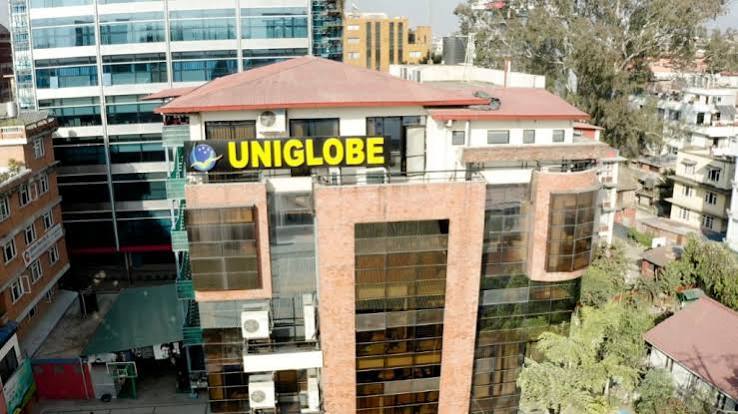

Uniglobe Secondary School/College
Bringing the best together.
0
Stories
0
Activities
0
Events
0
Photos
About Uniglobe Secondary School/College
About Uniglobe Secondary School/College
Choosing a college after the Secondary Education Examination (SEE) is an important decision in a student's academic journey. It is a time when interests begin to take shape, ambitions become clearer and young people start exploring the possibilities that may define their future. A good higher-secondary education should therefore do more than prepare students for examinations. It should help them develop the ability to think independently, understand the world around them and make informed decisions about their academic and professional paths.
Uniglobe Secondary School/College, located at Kamaladi, near Ganesh Mandir, Kathmandu, is a higher-secondary institution offering programmes in Science, Management and Law. The institution aims to provide students with an education that combines academic knowledge with practical learning, critical thinking, problem-solving and personal development. Its educational philosophy emphasises research-oriented learning, professional competence, innovation and the preparation of students for further education and future careers.
The institution's stated vision is to develop into a research-driven centre of learning in Science, Management, Law and other disciplines relevant to contemporary careers. It seeks to create an educational environment in which students can develop their abilities, explore their interests and prepare to contribute to society.
For students entering Grades 11 and 12, these two years represent a transition from general education towards more specialised academic interests. Whether a student is drawn to scientific investigation, business and entrepreneurship, or the study of law and justice, the learning environment can play an important role in shaping that transition.
Uniglobe Secondary School/College seeks to bring these dimensions together through its academic programmes, teaching approach, educational resources and co-curricular and extracurricular activities.
Academic Programmes
Science: Exploring Knowledge Through Inquiry and Experimentation
Science education offers students an opportunity to understand the natural world through observation, experimentation, analysis and evidence-based reasoning. For students interested in medicine, engineering, information technology and scientific research, the Science programme can provide an important foundation for further study.
Uniglobe Secondary School/College offers a +2 Science programme designed to develop students' understanding of scientific principles while encouraging curiosity and analytical thinking. The institution's programme information identifies areas associated with general science, medical science, engineering and information technology.
Science education involves more than learning definitions, formulas and theories. Students need opportunities to examine how scientific principles work, investigate questions and understand the relationship between theoretical knowledge and practical application.
Laboratory activities can help students develop these abilities by allowing them to observe phenomena, conduct experiments and interpret results. Problem-solving exercises also encourage them to approach unfamiliar questions systematically rather than rely entirely on memorisation.
A foundation in Science can support further study in fields such as medicine, engineering, pharmacy, agriculture, computer science and other scientific and technological disciplines, subject to the eligibility requirements of the respective programmes.
For students who enjoy asking questions, examining evidence and understanding how things work, the Science programme can provide a pathway towards a wide range of academic possibilities.
Management: Understanding Business, Economics and Entrepreneurship
Management education introduces students to the principles that shape businesses, organisations and economic activities. It is particularly relevant for those interested in accounting, finance, marketing, entrepreneurship, human resource management and business administration.
Uniglobe Secondary School/College's +2 Management programme seeks to combine theoretical knowledge with practical skills development. According to the institution's programme description, students explore areas such as marketing, finance, human resources and entrepreneurship.
These fields provide different perspectives on how organisations operate. Finance and accounting help explain how money and resources are managed. Marketing examines how businesses understand customers and communicate the value of their products or services. Human resource management focuses on people, workplace relationships and organisational development. Entrepreneurship explores how ideas can be transformed into business initiatives.
Management education can also strengthen transferable skills, including communication, numerical reasoning, teamwork, decision-making and problem-solving. Case studies and interactive learning activities can help students connect classroom concepts with situations encountered in the business world.
After completing Grade 12, students may pursue further education in areas such as business administration, business studies, accounting, finance, economics and related disciplines, depending on the admission criteria of the institutions they choose.
For students considering careers in business or seeking a broader understanding of economic and organisational life, Management can provide a useful academic foundation.
Law: Developing an Understanding of Justice and Society
Law is closely connected with the institutions, rights, responsibilities and relationships that shape society. Studying legal concepts can help students understand how rules are established, how disputes are addressed and how justice is pursued within a legal system.
Uniglobe Secondary School/College offers a +2 Law programme that introduces students to legal learning while emphasising critical analysis, persuasive writing and effective communication. Its programme description highlights interactive lectures, debates and mock trials as approaches intended to connect legal concepts with practical situations.
Debates can encourage students to examine legal and social questions from different perspectives. Mock trials provide a setting in which learners can explore courtroom procedures and practise presenting arguments. Analytical writing helps them organise evidence, evaluate competing viewpoints and communicate conclusions logically.
The value of studying law at the higher-secondary level extends beyond preparation for a future legal profession. An understanding of rights, duties and legal institutions can also help students become more informed citizens.
Students interested in pursuing law at university or exploring related fields can use the +2 programme as an early introduction to legal concepts and reasoning. Further study and professional practice remain subject to the relevant admission requirements and qualifications.
From Classroom Learning to Practical Understanding
There is an important difference between memorising information for an examination and understanding a subject well enough to apply it in unfamiliar situations.
Uniglobe Secondary School/College states that its educational approach combines theoretical instruction with practical application. Its institutional philosophy emphasises problem-solving, project-based teaching, research-driven knowledge and innovative learning methods.
These approaches can support students in developing a more active relationship with their education. A scientific investigation requires observation and analysis. A business case study encourages students to assess a situation and consider possible decisions. A legal debate requires careful reasoning and the ability to support an argument.
Such activities also help students learn how to work with others, manage responsibilities and communicate ideas clearly.
The effectiveness of practical learning depends on how consistently these opportunities are integrated into academic programmes. When supported by appropriate guidance and meaningful feedback, they can help students develop habits of inquiry and independent thinking that remain valuable beyond the classroom.
For students in Grades 11 and 12, these experiences can make academic learning more engaging while preparing them for the demands of university education.
Laboratories, Library and Academic Facilities
An effective learning environment requires appropriate facilities, access to information and spaces that support both guided instruction and independent study.
Uniglobe Secondary School/College identifies classrooms, laboratories, a library, computer facilities, a conference hall, a cafeteria and sports facilities among its campus resources.
The institution's facilities page describes classrooms equipped with multimedia and internet access, along with air-conditioning and safety-related provisions. Such resources can support technology-assisted teaching and make it easier to present complex concepts through different learning materials.
Laboratories are particularly important for Science students, who need opportunities to connect theoretical principles with observation and experimentation. Practical activities can help students develop familiarity with scientific procedures and understand how evidence is collected and interpreted.
The college library contains reference materials, books, encyclopedias, dictionaries, periodicals and other learning resources. The institution also mentions electronic learning resources, providing additional options for research and independent study.
A library contributes to education in ways that extend beyond access to textbooks. It can encourage students to read widely, investigate unfamiliar topics and develop the habit of learning independently.
The computer laboratory provides access to digital tools and internet-based resources for academic work. Digital literacy is increasingly relevant across all three programmes, whether students are conducting research, preparing presentations or working with subject-related information.
The institution also identifies a conference hall with a stated capacity of more than 300 seats. Its facilities page describes the hall as a venue for presentations, conferences, exhibitions, performances and other co-curricular activities.
Together, these resources are intended to support a learning environment in which classroom instruction can be complemented by practical work, research and student participation.
Learning Beyond the Academic Timetable
A student's education is shaped not only by lessons and examinations but also by experiences outside the regular classroom.
Uniglobe Secondary School/College provides opportunities for co-curricular and extracurricular engagement through student activities, events, excursions, sports and other institutional programmes. Its website includes dedicated sections for extracurricular activities (ECA), co-curricular activities (CCA), educational tours, social work and alumni engagement.
These activities can help students explore interests that may not be fully expressed through academic subjects alone.
Sports encourage physical activity, discipline, cooperation and respect for shared rules. Group activities create opportunities to build friendships and learn how to work towards common goals. Excursions can expose students to environments and experiences beyond their usual academic settings.
Social-work initiatives, including the institution's documented orphanage visit, introduce students to opportunities for community engagement. Such activities can encourage reflection on social responsibility and the importance of contributing to the wider community.
The institution also features events such as orientation programmes, farewell programmes, music festivals and sports meets. These gatherings provide opportunities for students to participate in institutional life, develop confidence and create shared experiences.
Participation in extracurricular activities does not automatically produce leadership or communication skills. However, when students take meaningful responsibilities, work collaboratively and reflect on their experiences, such activities can contribute to their personal and social development.
Science, Creativity and Academic Engagement
Scientific curiosity develops when students have opportunities to move beyond established answers and investigate questions of their own.
Uniglobe Secondary School/College features the Young Scientist Summit among its institutional events. Such an event can provide a setting for scientific discussion, presentation and the exchange of ideas, while giving students opportunities to engage with scientific and technological interests.
Research-oriented learning encourages students to ask questions, examine information and evaluate evidence. These abilities are relevant not only to Science but also to Management and Law, where sound decisions depend on the careful assessment of facts and competing explanations.
For a Science student, an investigation may involve understanding a natural phenomenon or examining a technological problem. A Management student may explore a business challenge, while a Law student may examine a question involving rights, responsibilities or legal principles.
Although the subject matter differs, all three fields benefit from curiosity, analytical thinking and the ability to communicate reasoned conclusions.
The institution's stated emphasis on research, innovation and problem-solving reflects the importance of these abilities in contemporary education.
Developing Confidence, Responsibility and Leadership
Education is not solely about acquiring knowledge. It also involves learning how to use that knowledge responsibly and how to interact constructively with others.
Uniglobe Secondary School/College's institutional philosophy emphasises the development of future scientists, researchers, professionals, entrepreneurs, managers, legal experts and responsible citizens. Its stated objectives include encouraging leadership, practical learning, innovation and contributions to society.
These ambitions recognise that students will eventually enter environments in which they must make decisions, manage responsibilities and work with people whose experiences and perspectives may differ from their own.
Confidence can develop through participation in presentations, discussions, group assignments and institutional activities. Responsibility grows when students are expected to meet commitments, respect others and take ownership of their work.
Leadership, similarly, is not limited to holding a formal position. It can involve listening carefully, helping a group reach a decision, organising an activity or accepting responsibility when challenges arise.
The higher-secondary years provide an important period for developing these habits. A supportive learning environment can help students recognise their strengths, work on their limitations and gradually become more independent learners.
Admission and Academic Preparation
The transition from SEE to higher-secondary education requires students to consider their academic interests, eligibility and future plans.
Uniglobe Secondary School/College offers programmes in Science, Management and Law under the National Examination Board (NEB) framework, as stated on its official website. Its published admission information describes a process involving registration, an entrance examination and an interview.
Students considering admission should confirm the current eligibility criteria, application deadlines, required documents, entrance examination arrangements, fees and scholarship provisions directly with the institution. Subject combinations and admission requirements should also be checked before making a final decision.
Choosing a programme requires more than following the choices of friends or selecting a stream based on its popularity. Students should consider the subjects they enjoy, the skills they wish to develop and the further study options associated with each programme.
Those interested in scientific investigation may prefer Science; students drawn to business and economic questions may consider Management; and learners interested in justice, legal reasoning and social institutions may explore Law.
Teachers, family members and academic advisers can help students assess these options. Ultimately, the decision should reflect the student's interests, abilities and willingness to engage with the demands of the chosen programme.
Preparing for the Next Stage of Life
The two years of higher-secondary education can be formative. They are a period in which students begin to understand their academic strengths, develop new interests and consider the possibilities that lie beyond school.
A good college experience should help students build a sound academic foundation while also encouraging them to become thoughtful, responsible and adaptable individuals.
Uniglobe Secondary School/College's educational approach brings together three distinct academic pathways—Science, Management and Law—with an emphasis on practical learning, research, facilities, student activities and personal development.
For students and parents considering the institution, the important question is not simply whether a college offers a particular programme or a long list of facilities. It is whether the teaching approach, academic environment, available resources and opportunities for participation suit the student's needs and aspirations.
A college cannot determine every step of a student's future. It can, however, help create the conditions in which students learn to ask better questions, approach challenges systematically and make more informed decisions.
That is the broader purpose of higher-secondary education: not merely to complete two academic years, but to develop the knowledge, habits and confidence that students can carry into university, professional life and society.
Uniglobe Secondary School/College at a Glance
Institution: Uniglobe Secondary School/College
Location: Kamaladi, near Ganesh Mandir, Kathmandu, Nepal
Education Level: +2 / Higher Secondary
Academic Programmes: Science, Management and Law
Affiliation: National Examination Board (NEB), as stated on the institution's website
Programme Duration: Two years (Grades 11 and 12)
Academic Facilities: Classrooms with multimedia and internet access, laboratories, library, computer laboratory and conference hall
Campus Facilities: Cafeteria, sports facilities, study areas and transportation services
Student Development: Co-curricular and extracurricular activities, educational excursions, sports, social work and institutional events
Academic Emphasis: Practical learning, research, critical thinking, problem-solving, innovation, leadership and social responsibility
Admission Process: Registration, entrance examination and interview, according to the published website information
Contact & Leadership
Leadership
Dr. Ganesh Regmi
Principal
Dr. Khagendra P Ojha
Executive Chairman
Latest from Uniglobe Secondary School/College
Nothing published for this institution yet.