


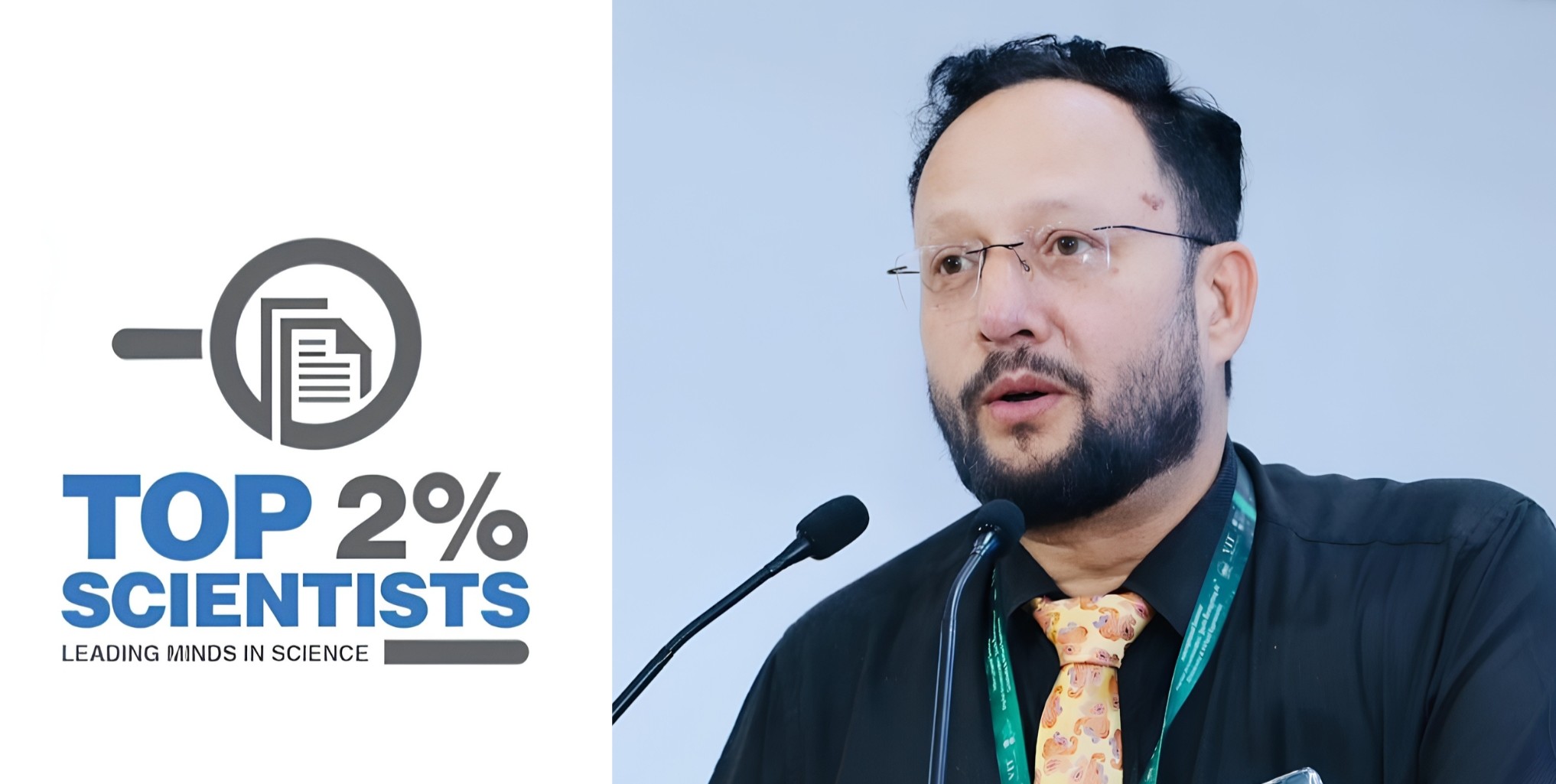
Prof. Dr. Sudan Jha, an artificial intelligence (AI) expert at Kathmandu University (KU) and a member of Nepal’s National Planning Commission, has once again been listed among the world’s top 2% of scientists. He was recognized in the 2026 Single-Year Scientific Impact Rankings under Artificial Intelligence and Image Processing, jointly compiled by Stanford University, USA, and international academic publisher Elsevier. He was also included in the 2025 list and is the only scientist from Nepal represented in this field.
According to the published rankings, Dr. Jha ranks 151,086th globally overall and 6,907th in Artificial Intelligence and Image Processing, among approximately 517,648 researchers in the field.
The rankings are based on data from Elsevier’s Scopus database and assess research impact using indicators such as publication quality, citations, the H-index and HM-index, authorship contributions, and a composite C-score.
With 24 years of experience in teaching, academic research, and the technology industry, Dr. Jha has served as director of KU’s IT Centre and principal investigator of its IoT R&D Lab. His research interests include the Internet of Things (IoT), AI, deep learning, neutrosophic principles, smart governance, and 5G technology. He holds four patents and has authored or edited 15 books, alongside publishing more than 127 international research papers. He has also served as an expert adviser on Nepal’s national AI policy, technical director of Nepal Television, and adviser to the Nepal Telecommunications Authority.
The 2026 Single-Year list includes 31 scientists affiliated with institutions across Nepal, one more than in 2025. Nepal ranks 92nd worldwide by the number of researchers listed. The separate Career-Long category, which measures research impact over a scientist’s entire career, includes eight Nepali scientists.
Dr. Meghnath L. Dhimal of the Nepal Health Research Council leads Nepal’s Single-Year list, ranking 34,757th globally and 535th in General and Internal Medicine. Dr. Bhishma Karki of Tribhuvan University ranks second in Chemical Physics, followed by Dr. Ranjit Kumar Sah of Tribhuvan University Teaching Hospital in Microbiology.
Tribhuvan University has the highest institutional representation, with eight researchers on the list. Other scientists are affiliated with institutions including the Nepal Health Research Council, B.P. Koirala Institute of Health Sciences, the International Centre for Integrated Mountain Development (ICIMOD), the International Water Management Institute (IWMI), Gandaki University, Kathmandu University, and the Nepal Academy of Science and Technology (NAST).
In the Career-Long category, Gopal Bahadur Thapa of the Nepal Agroforestry Foundation leads Nepal’s representation. The group also includes three researchers from Tribhuvan University and scientists affiliated with CIMMYT, the Nepal Health Research Council, and B.P. Koirala Institute of Health Sciences, as well as an independent researcher.
Nepali scientists have made contributions across medicine, chemical physics, microbiology, nuclear chemistry, psychiatry, applied physics, atmospheric science, environmental engineering, ecology, pharmacy, public health, biotechnology, and forestry. Dr. Jha’s inclusion marks Nepal’s sole representation in the advanced information technology field of Artificial Intelligence and Image Processing.
The number of Nepali scientists in the Single-Year list has risen from just nine in 2020 to 31 in 2026, reflecting the growing international visibility of Nepal’s research community despite limited resources.