

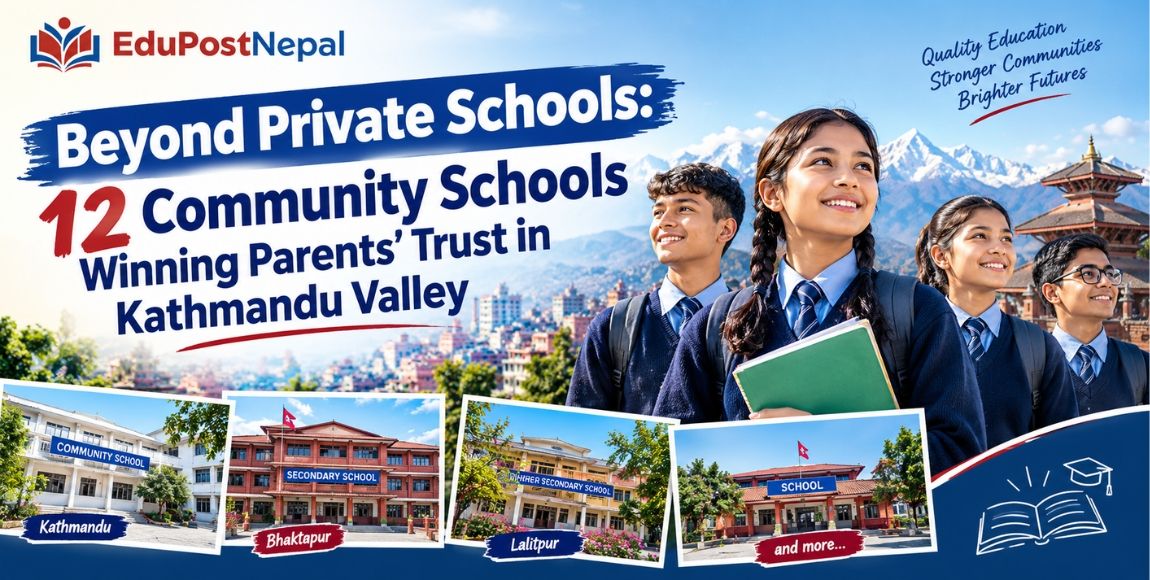
Strong academic results, competitive admission processes, growing student enrolment and innovative teaching practices have helped several community schools in Kathmandu Valley become preferred choices for parents.
At a time when many community schools across Nepal are struggling with declining enrolment and limited resources, some institutions in Kathmandu Valley are attracting more students than they can accommodate. In several schools, applicants outnumber available seats, prompting admission tests and competitive selection processes.
Their appeal is not based solely on affordable or free education. Academic performance, school management, teachers’ commitment, teaching methods and opportunities for students have also contributed to their growing reputation.
Although the overall condition of community schools remains uneven, the experiences of these institutions demonstrate how public schools can compete with private institutions through effective management, community participation and a focus on educational quality.
12 Notable Community Schools in Kathmandu Valley
1. Bishwo Niketan Secondary School, Tripureshwor
Established in 2003 BS, Bishwo Niketan Secondary School in Tripureshwor is among the well-known community schools in Kathmandu. According to a report published in April 2026, the school had around 4,000 students and 135 teachers and staff members.
The school received the National Education Award in 2074 and 2075 BS. In 2078 BS, ten of its students secured full scholarships to study MBBS, while more than 40 received opportunities for free engineering education.
The level of trust among its own staff is also noteworthy. According to the same report, more than 90 per cent of the school's staff members send their children to Bishwo Niketan.
2. Bageshwori Secondary School, Bhaktapur
Located in Chyamasingh, Bhaktapur, Bageshwori Secondary School is one of the prominent community schools in the district. It has attracted considerable student interest, with admission tests conducted because the number of applicants often exceeds the available seats.
The school demonstrates that community institutions can attract students through academic quality and effective management. Its competitive admission process also reflects the demand for places at the school.
3. Tarun Secondary School, Balaju
Established in 2030 BS, Tarun Secondary School in Balaju has built a reputation through its academic achievements and student-centred teaching practices. The school has secured four first-place national awards and one second-place award, according to published reports. It has around 2,000 students.
The school offers English-medium instruction and provides free education and lunch. Technology-enabled classrooms, its 'Book Free Friday' initiative and skill-based activities are among its notable practices.
Tarun has also received the British Council's International School Award 2023. Kathmandu Metropolitan City has recognised it under its 'One Ward, One Model School' initiative.
4. Gyanodaya Secondary School, Bafal
Established in 2029 BS, Gyanodaya Secondary School in Bafal is another prominent community school in Kathmandu. According to published reports, it has around 4,000 students.
The school gained attention after achieving a 90 per cent pass rate in the 2052 BS School Leaving Certificate (SLC) examination. It has continued to introduce initiatives that connect classroom learning with practical skills.
'Book Free Friday' and 'Education with Skills' are among its initiatives aimed at encouraging learning beyond conventional textbooks. The school has also experienced significant demand for admission.
5. Tripadma Vidyashram Secondary School, Pulchowk
Located in Pulchowk, Lalitpur, Tripadma Vidyashram Secondary School was established in 2004 BS. It is one of the older community schools in the Valley, offering education from Early Childhood Development (ECD) to Grade 10, along with Management and Education programmes at Grades 11 and 12.
The school also runs a Junior Computer Technician programme affiliated with the Council for Technical Education and Vocational Training (CTEVT).
According to published reports, the school achieved a 100 per cent pass rate in the Secondary Education Examination (SEE) in 2080 BS.
6. Medha Secondary School, Bhaktapur
Medha Secondary School, located in Tekhapukhu, Bhaktapur, was established in 2004 BS as Shanti Bhakta School. It was renamed Medha Secondary School in 2071 BS.
The school has around 800 students. In the 2080 BS SEE examination, all 115 students who appeared from the school passed.
Its academic performance has drawn attention in Bhaktapur, where the school has demonstrated that a community institution can achieve strong results through collective efforts involving teachers, students and parents.
7. Bhanu Secondary School (Durbar High School), Rani Pokhari
Bhanu Secondary School, popularly known as Durbar High School, is located near Rani Pokhari in Kathmandu. Established in 1910 BS, it is recognised as Nepal's first formal school.
Initially established for the education of members of the ruling families, the school was opened to the general public in 1942 BS.
The school building was damaged in the 2015 earthquake and later reconstructed with support from the Government of China. It has since incorporated technology into classroom teaching, including the use of projectors and information and communication technology-based learning.
8. Shram National Secondary School, Kumarigal
Located in Kumarigal, Kathmandu Metropolitan City Ward No. 7, Shram National Secondary School has been conducting its academic activities despite limited physical infrastructure.
The school occupies a campus of approximately one ropani, with 13 classrooms. Due to student numbers, it operates in two shifts and has around 800 students, according to published reports.
Principal Narayan Prasad Nepal has been leading the school since 2055 BS. Since 2058 BS, the school has also been conducting additional classes in English, Mathematics and Science on Saturdays.
Extra classes for students who need academic support, 'Book Free Friday' and technology-based teaching are among its practices. The school also recorded encouraging SEE results between 2078 and 2080 BS.
9. Mahendra National Secondary School, Baluwatar
Mahendra National Secondary School in Baluwatar was established in 1956 as a primary school. It gradually expanded to lower secondary and secondary levels before extending its programmes to higher secondary education.
The school's development has been supported by local community participation and the efforts of its teachers. It has also worked to improve its teaching practices and learning environment over time.
10. Janakalyan Secondary School, Boudha
Janakalyan Secondary School in Boudha, Kathmandu, is another community school that has experienced significant demand for admission.
According to a report on its 2080 BS admission process, the school planned to enrol around 250 new students that year. Approximately 2,500 students had appeared in its final examinations in the preceding academic session.
The school reportedly conducted entrance examinations for Grades 4 to 9 and interviews for admission to lower grades. The number of applicants relative to available seats reflects the school's appeal among local families.
11. Adarsha Shaul Yuvak Secondary School, Bungamati
Adarsha Shaul Yuvak Secondary School in Bungamati, Lalitpur, is another community institution attracting a considerable number of students.
A report on community-school admissions in 2080 BS noted that more than 2,000 students had appeared in the school's final examinations in the previous academic year. The figure indicates the school's substantial student population and its importance in the local education landscape.
12. Khwopa Secondary School, Bhaktapur
Khwopa Secondary School, operated by Bhaktapur Municipality, is an important institution in the municipality's public education initiative.
The school has become a preferred choice for students and parents in Bhaktapur. Its academic programmes and demand for admission reflect the potential of locally managed public institutions to earn the trust of families.
Khwopa also represents the role local governments can play in strengthening public education through investment, institutional management and academic programmes.
Other Notable Schools Across the Valley
The community schools attracting attention in Kathmandu Valley are not limited to these 12 institutions. Shramik Shanti Secondary School in Chyasal and Harisiddhi Secondary School in Harisiddhi, Lalitpur, are among other schools that have featured in discussions about student demand and community-school performance.
Similarly, the Military Residential College in Sallaghari, Bhaktapur, is another well-known educational institution in the district. However, its institutional structure differs from that of ordinary community schools, so it is more appropriate to mention it separately rather than include it in a list of community schools.
What Makes These Schools Attractive?
The experiences of these schools point to several factors that contribute to the growing appeal of community education. Effective school leadership, committed teachers, parental involvement and support from local communities are among the key elements.
Technology-enabled classrooms, additional academic support, skill-based programmes, student-centred teaching methods and regular assessment have also helped improve the learning environment.
Kathmandu Metropolitan City has also taken steps to integrate technology into the management and monitoring of community schools. According to a report published in September 2026, the city had incorporated 36,280 students, teachers and staff members from 83 schools into an integrated digital attendance system.
However, high admission demand alone should not be considered the ultimate measure of a school's quality. Competitive admission processes can also create challenges for students who cannot secure a place in a nearby public school. Ensuring equitable access, particularly for children from economically disadvantaged backgrounds, remains an important responsibility of community schools.
The success of these institutions can help rebuild public confidence in community education. Yet, the achievements of a few schools should not be taken as a reflection of the overall condition of public education in Nepal.
The larger challenge is to extend effective practices to more schools while ensuring that every child has access to quality education, regardless of their economic background.